Major pledges at AI Summit in India
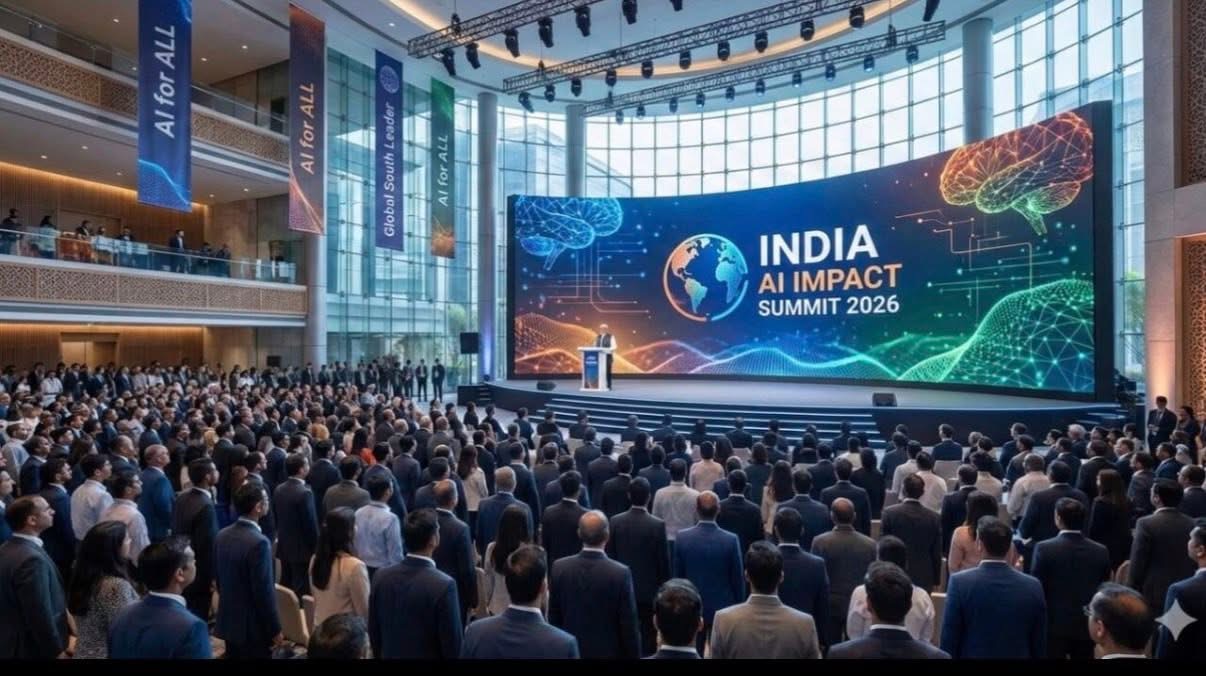
At the India AI Impact Summit this week, hundreds of billions of dollars in artificial intelligence investments were announced, landmark business deals sealed, and sharp disagreements over global AI governance were laid bare. The summit featured more than 300 exhibitors and 500 sessions, drawing over 200,000 participants. The chief executives of Google, OpenAI, Microsoft and India’s biggest technology companies were present, alongside United Nations Secretary-General António Guterres. India’s Prime Minister’s declaration Addressing the Leaders’ Plenary on Thursday, India’s Prime Minister, Narendra Modi, struck an ambitious tone, declaring that humanity has always turned disruptions into opportunities and that AI represents precisely such a moment. “We must give AI an open sky, and keep the command in our hands,” Mr Modi said, calling for a roadmap that ensures AI “delivers the right impact” through “the right decisions, at the right time, with the right policies.” Mr Modi also announced that India is adding computing capacity for its innovators, providing world-class GPU infrastructure to startups at affordable rates, and has created an AI Fund through which more than 7,500 datasets and 270 AI models have been shared as national resources. India’s Technology Minister Ashwini Vaishnaw said $200 billion in AI investment was expected to flow into India, much of it from abroad. Recent data from Stanford University ranked India third globally in AI competitiveness, behind only the United States and China. Major deals announced The summit delivered many significant commercial announcements. American AI company Anthropic’s chief executive, Dario Amodei, announced a partnership with Indian tech giant Infosys to integrate services including regulatory compliance reporting and precision engineering. Infosys shares jumped five per cent on Tuesday following the announcement. OpenAI, the company behind ChatGPT, announced a similar deal with Tata Consulting Services to develop AI infrastructure in India and train more employees on AI tools. OpenAI also announced it would open its first Indian office this year, adding that Indian users now share 33 per cent more data with ChatGPT than Americans do. Private equity firm Blackstone invested $600 million in Neysa, an Indian cloud services provider. The Adani Group pledged $100 billion to build clean-energy-powered data centres by 2035, while Reliance and Tata also announced significant investments in new data infrastructure. Anthropic’s flagship AI model, Claude, already counts India as its second-largest market, accounting for nearly six per cent of worldwide usage. Google, Microsoft, and Amazon have separately committed a combined $68 billion in AI and cloud infrastructure investments in India through 2030. The Delhi Declaration Minister Vaishnaw said at least 70 countries were expected to sign what has been dubbed the “Delhi Declaration” on AI — a pledge that “AI’s promise is best realised only when its benefits are shared by humanity,” according to a European Union press release. The final draft was to be released on Saturday, along with a full list of signatories. Separately, a set of voluntary “frontier AI commitments” announced by the Indian government outlined two key pillars: advancing understanding of real-world AI usage through anonymised and aggregated data to support policymaking on jobs, skills and economic transformation; and strengthening multilingual and contextual AI evaluations to ensure AI systems work effectively across languages, cultures and real-world use cases — particularly in under-represented languages across the Global South. UN Secretary-General Guterres called for a $3 billion global fund to support AI capacity-building in developing countries, covering skills development, data access and affordable computing infrastructure. US rejects global AI governance In one of the summit’s sharpest declarations, the White House made clear that Washington would resist any attempt to regulate AI at the international level. “We totally reject global governance of AI,” said White House official Michael Kratsios on Friday. The statement underlined a growing tension at these summits between countries seeking binding international safeguards and those — led by the United States — favouring voluntary, market-driven approaches. Critics noted that the official frontier AI commitments released at the summit made no mention of previous summits’ efforts to coordinate government action on AI risks. Anthropic’s Amodei sought to address anxiety by outlining AI’s potential for breakthroughs in healthcare and poverty reduction. “On the positive side, we have the potential to cure diseases that have been incurable for thousands of years, to radically improve human health, and to lift billions out of poverty, including in the Global South,” he said. Nigerian experts speak, showcase AI tools Nigeria made a strong impression at the summit, with experts contributing to high-level panel discussions and research presentations throughout the event. Among the Nigerian participants who took the stage were Toyosi Akerele-Ogunsiji, Olayinka David-West, Kola Ijasan, Olubayo (Bayo) Adekanmbi, and Tajuddeen Gwadabe — collectively underscoring Nigeria’s growing influence in AI policy, research, and innovation on the global stage. READ ALSO: What world leaders at Indian summit said about AI’s future The Nigeria AI Collective pavilion drew considerable interest from international visitors, many of whom arrived with an eye toward building strategic partnerships and expanding their work into new markets. Student attendees were equally enthusiastic, actively exploring internship opportunities with Nigerian tech and AI companies. The Nigeria AI Collective also maintained a presence at the exhibition grounds, where Nigerian innovators showcased locally built AI tools reflecting efforts to design systems tailored to local contexts. Nubia AI, one of the showcased platforms, focuses on transforming complex datasets into structured stories and visual insights to improve public understanding and accountability. DUBAWA AI, another tool presented, converts audio recordings into text while accounting for local languages and tonal variations—addressing persistent gaps in global speech recognition systems operating in African linguistic environments. The Minister of Communications, Innovation and Digital Economy, Bosun Tijani, was represented by the National Director of the National Centre for Artificial Intelligence and Robotics (NCAIR), Olubunmi Ajala. Mr Ajala participated in the Nigeria AI Collective Global Meetup in New Delhi and visited the Nigeria AI Collective pavilion at the AI Impact Expo — reaffirming Nigeria’s institutional commitment to advancing AI development and fostering meaningful international collaboration. Share this: Click to share on X (Opens in new window) X Click to share on Facebook (Opens in new window) Facebook Click to share on WhatsApp (Opens in new window) WhatsApp Click to share on Telegram (Opens in new window) Telegram Click to share on LinkedIn (Opens in new window) LinkedIn Click to email a link to a friend (Opens in new window) Email Click to print (Opens in new window) Print
SOURCE: https://www.premiumtimesng.com/news/top-news/858346-major-pledges-at-ai-summit-in-india.html