Top AI CEOs speak about regulation of artificial intelligence, challenges, opportunities
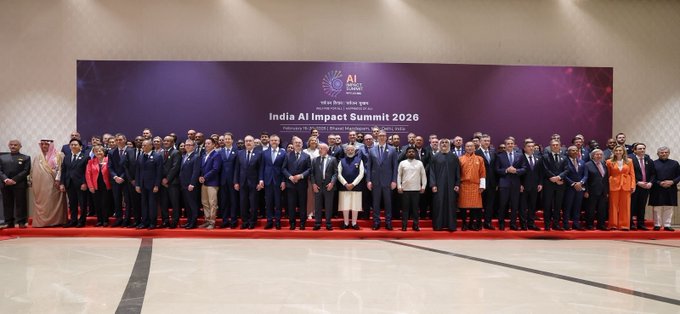
India is hosting one of the most consequential artificial intelligence gatherings the world has seen this week. The event taking place in New Delhi could redefine how AI is built, governed, and shared across the developing world. The India AI Impact Summit, which opened on Monday, 16 February, at Bharat Mandapam in New Delhi, has drawn more than 500 AI leaders, 100 founders and chief executives, 150 academics and researchers, and nearly 400 chief technology officers, vice presidents, and philanthropists from over 100 countries. It is the first time the global summit has been held in a developing nation — a deliberate signal that the Global South intends to move from the margins to the centre of the AI conversation. The gathering has also drawn more than 20 heads of state and government, over 60 ministers and vice ministers, and representatives from multilateral organisations spanning more than 100 countries. ‘Regulate AI urgently’ OpenAI chief executive Sam Altman used the summit to renew his call for global oversight of artificial intelligence, warning that concentration of the technology in a single company or country posed an existential danger. “Centralisation of this technology in one company or country could lead to ruin,” Mr Altman said on Thursday. “This is not to suggest that we won’t need any regulation or safeguards. We obviously do, urgently, like we have for other powerful technologies.” Mr Altman, whose company developed ChatGPT, has previously pushed for global oversight but warned last year that overly tight regulation could put the United States at a disadvantage in the global AI race. He also spoke about India’s potential. “India’s AI opportunity is amazing. This is one of our fastest-growing markets in the world — maybe the fastest at this point. It is certainly the fastest for OpenAI Codex. More than 100 million people use ChatGPT every week,” he said in a keynote address. On the question of revenue, Mr Altman said OpenAI was exploring advertising within ChatGPT as one of several options to chart a path to profitability for investors who have poured roughly $70 billion into the company. The company is also said to be finalising a $100 billion fundraising round. “I think we still have some work to do to figure out the exact ad format that’s going to work best,” he said, adding that Instagram-style ads — where users discover products they might not otherwise have found — represented an attractive model. OpenAI plans to test advertising in the United States first before expanding to other markets. Despite mounting investor scrutiny over profitability timelines, Mr Altman said the company remained focused on growth. “We are growing at an extremely fast rate right now,” he said. “As long as we can have reasonable unit economics, we should focus on continuing to grow faster and faster, and we’ll get profitable when we think it makes sense.” In his address, Anthropic chief executive Dario Amodei outlined both the transformative promise and the serious risks of AI, which he described as following an exponential trajectory over the past decade comparable to “a Moore’s Law for intelligence.” He said AI models were now only a few years away from surpassing the cognitive capabilities of most humans across a wide range of tasks. “There are only a small number of years left for AI models to surpass the cognitive capabilities of most humans for most things,” “We’re increasingly close to what I’ve called a country of geniuses in a data centre — a set of AI agents more capable than most humans at most things, coordinating at superhuman speed,” he said. Mr Amodei said that the unprecedented level of capability would demand careful safeguards. He identified autonomous AI behaviour, potential misuse by individuals and governments, and large-scale economic displacement as among the most pressing risks. “Safety, predictability, and human control are essential,” he said. “The signature of AI is its ability to grow the global economic pie. For India, the upside is huge, but we must prepare for changes affecting jobs and economic structures.” On the benefits, Mr Amodei was equally emphatic. He said AI held the potential to cure diseases that had defied treatment for thousands of years, radically improve human health, and lift billions out of poverty — particularly in the Global South. “AI has big risks and big benefits, but here, the upside may be even greater than elsewhere,” he said. He added that AI tools could support medical research, improve diagnostics, and raise productivity across sectors. “For countries like India, with large populations and growing digital adoption, AI systems could widen access to services in healthcare, agriculture, and education,” he said. Speaker after speaker pointed to what AI could deliver, particularly for countries that have historically been left behind by technological revolutions. Modi, Ambani, Pichai, and Nilekani weigh in Indian Prime Minister Narendra Modi had earlier called for AI to serve humanity broadly, not just wealthy nations or corporations. “We must democratise AI. It must become a medium for inclusion and empowerment,” Mr Modi said. “We are entering an era where humans and intelligence systems co-create, co-work and co-evolve. We must resolve that AI is used for the global common good.” Mukesh Ambani, chairman of India’s Reliance Group, pushed back against fears that AI would eliminate jobs. “We will prove that AI does not take away jobs. Rather, it will create new high-skilled work opportunities,” he said, predicting that AI would usher in “an era of super abundance.” Google chief executive Sundar Pichai said artificial intelligence was the technology with the greatest potential he had encountered in his career. “No tech has me dreaming bigger than AI. We are on the cusp of hyper progress — discoveries that can help emerging economies leapfrog,” he said, adding that AI could solve some of the hardest problems in science. READ ALSO: Religious bodies warn of AI being used to undermine religion Infosys co-founder Nandan Nilekani offered a more cautionary note, warning that the global race in AI could take two possible directions. India can lead AI diffusion. Now in AI, there is a race to the top and a race to the bottom — and the race to the bottom is faster,” he said. Despite the optimism on display, researchers and campaigners attending the summit said stronger action was needed to address emerging harms, from job disruption and online abuse to the heavy electricity demands of AI data centres. The annual series began at Bletchley Park in Britain in 2023, then moved to Seoul and later to Paris. The India AI Impact Summit is the fourth annual gathering of its kind and the largest to date. Share this: Click to share on X (Opens in new window) X Click to share on Facebook (Opens in new window) Facebook Click to share on WhatsApp (Opens in new window) WhatsApp Click to share on Telegram (Opens in new window) Telegram Click to share on LinkedIn (Opens in new window) LinkedIn Click to email a link to a friend (Opens in new window) Email Click to print (Opens in new window) Print